
Blog · MVP · 9-min read
12 Best MVP Development Company Options for Startups (2026)

Choosing the right MVP development company can make or break your startup. This guide profiles 12 vetted agencies with real pricing data, Clutch ratings, and honest tradeoffs. Most funded startups spend $30K to $60K on an MVP built in 8 to 14 weeks. Horizon Labs tops our list for funded startups needing speed, accountability, and a 6-month code warranty, but the best pick depends on your budget, industry, and technical needs.
A McKinsey and Oxford University study found that large IT projects run 45% over budget and 7% over time, while delivering 56% less value than predicted. Scale that risk down to a startup with $200K in seed funding, and the margin for error shrinks to almost nothing.
The point of an MVP is to test product-market fit before you bet the farm. CB Insights analyzed 431 failed VC-backed companies and found 43% failed due to poor product-market fit. An MVP exists to prevent exactly that outcome. But if you hire the wrong MVP development company, you burn through runway on a product that ships late, works poorly, or solves the wrong problem entirely.
One experienced product consultant put it bluntly on Medium: “most of the projects that I have had to rescue have been because the agency made a mess of it.” That matches what practitioners report on Reddit and founder forums. The stakes are real.
This guide covers 12 agencies with specific pricing, verified Clutch ratings, and clear “best for” labels so you can match your situation to the right partner. It also includes a cost breakdown, a decision framework for agency vs. freelancer vs. in-house, and the red flags that experienced founders watch for.
Before scrolling through profiles, get clear on your evaluation criteria. Every agency looks impressive on its own website. These six factors separate the genuinely capable from the well-marketed.
Milestone-based billing. Never pay the full project cost upfront. Moveoapps states: “A legitimate agency will accept payment tied to delivery milestones. If they won’t, don’t hire them.” This is table stakes.
A real discovery phase. Companies that skip scoping and jump straight into code inevitably build the wrong thing. Look for agencies that run stakeholder workshops, user interviews, or at minimum a structured requirements sprint before writing a line of code.
Relevant portfolio work. Ask for projects in your specific domain. A fintech MVP and a consumer marketplace MVP require different expertise. Generic “we can build anything” positioning is a yellow flag.
Code ownership. You must own the IP. Period. Get this in writing before signing. If the contract is ambiguous about who owns the codebase, walk away.
Post-launch support. Shipping an MVP is the beginning, not the end. Ask about bug-fix warranties, monitoring setup, documentation quality, and growth retainer options. For a deeper look at what strong technical capabilities look like in practice, including warranty terms and handoff processes, it’s worth understanding what separates boutique agencies from body shops.
Realistic timelines and pricing. SumatoSoft warns: “If an agency guarantees to develop MVP in record time and at half of the average cost on the market, this is a red flag.” Underpricing means corners will be cut.

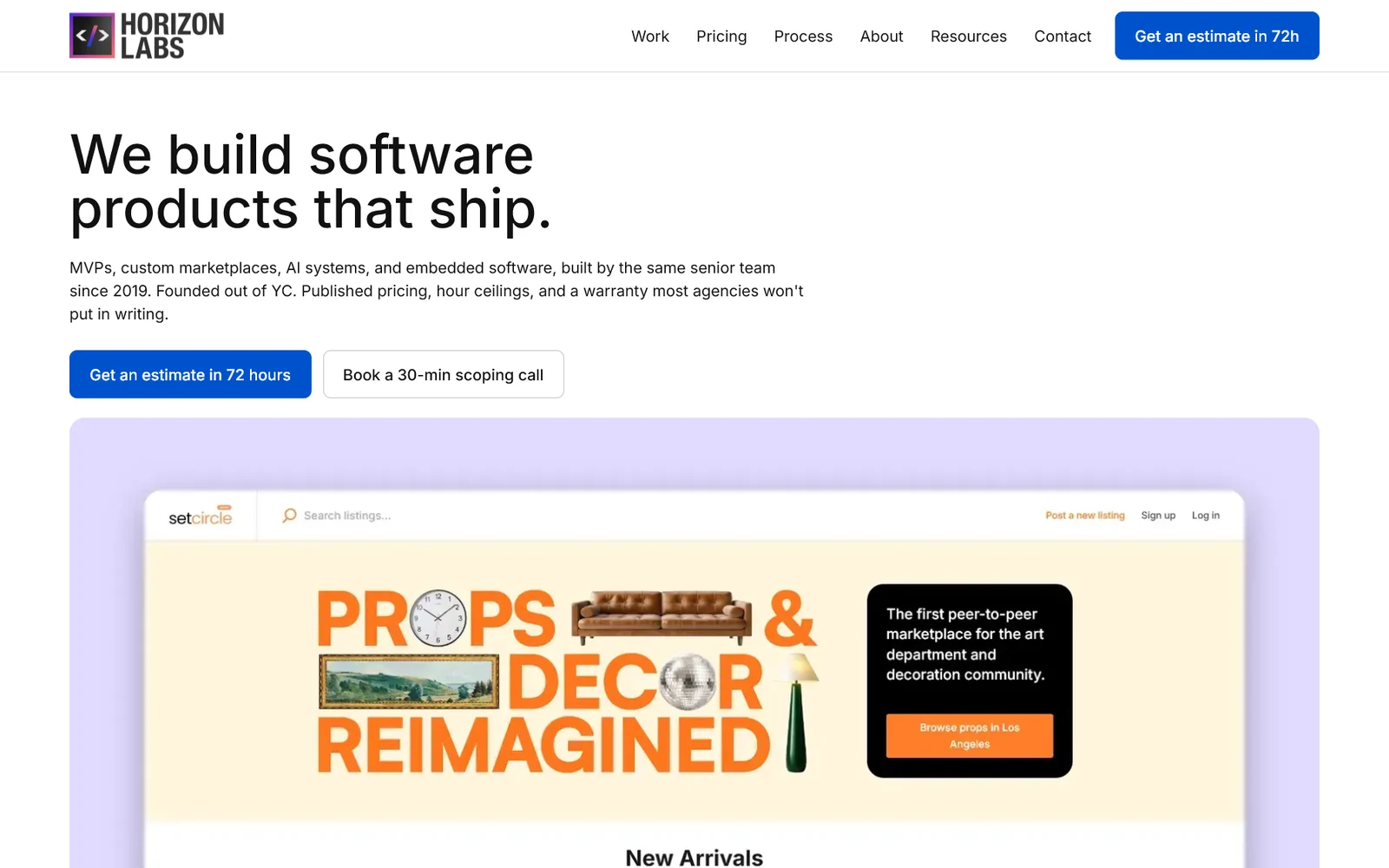
Best for: Funded startups (especially YC/accelerator-backed) needing a 6 to 12 week MVP with milestone-based billing and a post-launch code warranty.
Overview: Horizon Labs is a US-led boutique MVP development company with California leadership and a senior engineering team across the US and Türkiye. Founded in 2019, the agency has shipped over 60 MVPs and products, with five startups going from zero to exit. The founding team includes a Y Combinator alum CTO with a PhD in Computer Engineering and ex-VC leadership, which gives the firm genuine founder empathy alongside deep technical chops.
Pricing and engagement:
Standout strengths:
Notable clients: Bloom (YC W21), Arketa (YC S20), Flair Labs (YC S22), Cuboh (YC S19), RareWaters (acquired by Infinite Outdoors), Kidsy, Yura Health, TrueChoice.
Tradeoffs:
If you’re evaluating agencies and want to see the full client portfolio and case studies, that’s a good place to start.
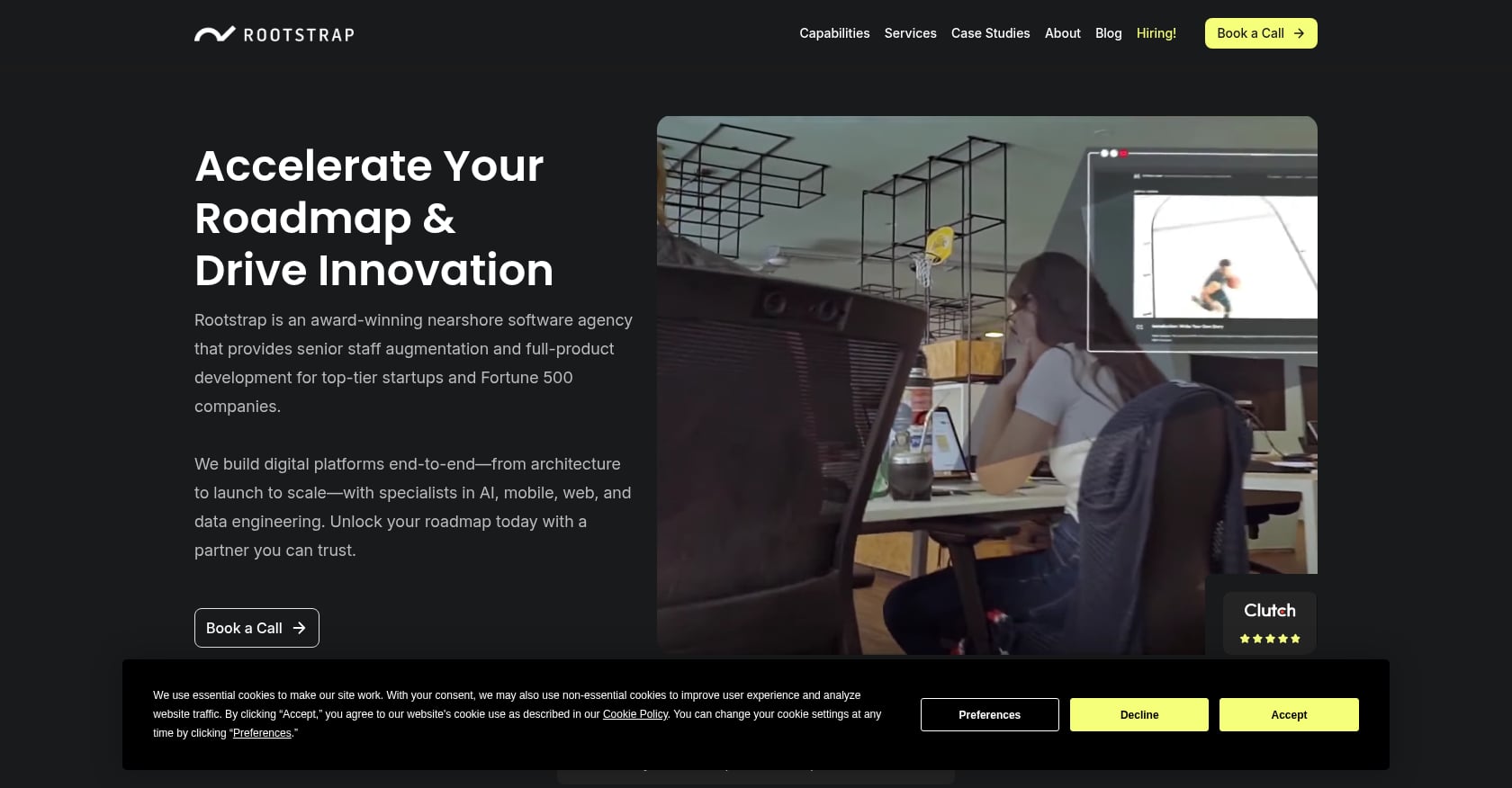
Best for: Mid-market startups and enterprises needing multi-discipline engineering at nearshore rates.
Overview: Rootstrap operates out of Beverly Hills with delivery teams in Buenos Aires and Montevideo. With 215+ engineers, they’re large enough to staff complex projects across mobile, web, data, and cloud simultaneously. Their model emphasizes strategic partnership: they challenge assumptions rather than just executing specs.
Pricing and engagement:
Standout strengths:
Tradeoffs:
Best for: Healthcare innovators and venture-backed startups that value structured discovery and HIPAA-compliance expertise.
Overview: Based entirely in Santa Monica, Sidebench runs a discovery-first process with rigorous stakeholder workshops and user interviews before any code gets written. Their healthcare focus, including HIPAA expertise, sets them apart in a crowded MVP development company market.
Pricing and engagement:
Standout strengths:
Tradeoffs:

Best for: Product-led companies wanting Ruby on Rails expertise, design sprints, and long-term product thinking.
Overview: thoughtbot is one of the most recognized names in Rails-ecosystem development. Based in Boston with multiple US offices, they’ve built a public methodology around design sprints, test-driven development, and open-source contributions. Their team thinks in terms of product outcomes, not just feature delivery.
Pricing and engagement:
Standout strengths:
Tradeoffs:
Best for: Non-technical founders wanting a co-founder-style agency with full product discovery.
Overview: Founded by ex-startup founders in Lisbon, Altar.io positions itself as the agency that thinks like a co-founder. Their clients have raised seed rounds using MVPs that Altar built, which speaks to the quality of their product thinking and technical execution.
Pricing and engagement:
Standout strengths:
Tradeoffs:
Best for: Mobile-first MVPs, especially complex app store products and blockchain projects.
Overview: Operating out of Florianópolis, Brazil with a US office, Cheesecake Labs has 100+ engineers and a strong track record in mobile product development. Their name is memorable, and their engineering is serious.
Pricing and engagement:
Standout strengths:
Tradeoffs:
Best for: Startups planning to scale beyond the MVP into a full product organization.
Overview: Formerly known as iTechArt, Vention operates from New York with global delivery. Their sweet spot is the startup-to-scale lifecycle: they’ll build your MVP, then grow the team alongside you as you raise and expand.
Pricing and engagement:
Standout strengths:
Tradeoffs:
Best for: Budget-conscious startups wanting enterprise-grade processes at offshore rates.
Overview: Simform has a US presence in Orlando paired with delivery teams in India. They offer the lowest hourly rates among quality agencies on this list, which matters when you’re stretching a seed round across product, marketing, and hiring.
Pricing and engagement:
Standout strengths:
Tradeoffs:
Best for: Design-led enterprise MVPs where UX is the primary differentiator.
Overview: Based in Poznań, Poland, Netguru has built a reputation for design-forward product development. They serve both US and European startups with a large team and transparent processes.
Pricing and engagement:
Standout strengths:
Tradeoffs:
Best for: Regulated industries like healthtech and fintech that need compliance from day one.
Overview: Innowise holds SOC 2, HIPAA, ISO 27001, and PCI DSS certifications, making them one of the few MVP development companies that can build in regulated markets without adding a compliance workstream after the fact.
Pricing and engagement:
Standout strengths:
Tradeoffs:
Best for: Idea-stage founders needing a concept-to-launch partner at a budget price point.
Overview: Based in Chennai, F22 Labs takes idea-stage founders from concept to launch in 12 to 16 weeks with 30+ developers and 6 UI/UX designers. They’re one of the more affordable options for founders still figuring out their product direction.
Pricing and engagement:
Standout strengths:
Tradeoffs:
Best for: SaaS founders who want pre-built solution components to cut development time.
Overview: DBB Software, based in Łódź, Poland, maintains a pre-built solutions library that can reduce development time by up to 50%. For SaaS MVPs with common patterns (user management, billing, dashboards), this approach gets you to market faster.
Pricing and engagement:
Standout strengths:
Tradeoffs:
The honest answer: it depends on what you’re building. But these ranges, drawn from multiple sources, give you a realistic baseline.
MVP Complexity
Cost Range
Timeline
No-code / Low-code MVP
$5,000–$15,000
4–6 weeks
Simple custom MVP (web app)
$15,000–$50,000
6–10 weeks
Mid-complexity (SaaS + integrations)
$30,000–$80,000
8–14 weeks
Complex (AI/fintech/healthtech)
$60,000–$150,000+
3–6 months
Enterprise MVP
$200,000–$500,000+
6–12 months
Ideas2IT reports MVP costs typically range from $10K to $50K for startups, climbing to $150K+ for complex AI-enabled builds. DBB Software puts the range at $15,000 to $120,000+ for most 2026 projects.
The sweet spot for funded startups? According to Modall, “Most funded startups find success in the $30K–$60K range. This budget allows for a professional team to build a robust product in 3 months.”
Hourly rates vary dramatically by region:
The most common mistake founders make is optimizing for hourly rate instead of total project cost. A $50/hr agency that takes 6 months costs more than a $200/hr agency that ships in 10 weeks. Factor in opportunity cost (delayed launch, delayed fundraising) and the math becomes even more lopsided.
For startups building marketplace products specifically, Horizon Labs offers Sharetribe marketplace development with discounted partner pricing and deep playbooks for rentals, services, and complex pricing flows.
This is a question every founder faces, and most MVP development company listicles skip it entirely. Here’s a practical framework.
Factor
Agency
Freelancer
In-House
Best when
Non-technical founder, need speed + process
Have technical co-founder to manage quality
6+ months runway, want to build a team
Typical MVP cost
$30K–$150K+
$15K–$60K
$150K+/yr per engineer
Speed
Fastest (existing team + process)
Moderate (single-point dependency)
Slowest (hiring takes 2–4 months)
Risk
Choose wrong partner
Bus factor = 1
Highest capital commitment
Post-MVP
May need to re-engage
May leave after project
Continuous iteration
One practitioner on Startups.com noted that in-house development is the first choice of many CXOs because the team stays fully involved. But the thread consensus was that agencies win when you lack a technical co-founder and need speed.
The key insight from Chrono Innovation: “If you have a technical co-founder, a freelancer makes more sense when someone on your team can evaluate code quality, manage the technical relationship, and identify problems before they compound.”
As a top Quora answer on the topic puts it bluntly: “Cash is the biggest thing. Without this, it’s hard to build the best product.” The decision ultimately comes down to how much runway you have and how quickly you need to validate.
For founders exploring GTM engineering and advisory alongside product development, combining both under one roof can reduce coordination overhead.
Most MVP development company lists haven’t caught up to this shift yet. AI coding tools like Cursor, GitHub Copilot, Lovable, and Replit Agent are accelerating prototyping dramatically. A UI that took a week to build in 2023 can now be scaffolded in hours.
But speed without discipline creates problems. Practitioners increasingly distinguish between “vibe-coded” MVPs (quickly assembled with AI tools but riddled with hidden tech debt) and AI-assisted builds where experienced engineers use AI to move faster while maintaining code quality, tests, and documentation.
Raftlabs reports LLM API costs usually run $0.01 to $0.10 per interaction, making AI features economically viable even at MVP scale. The agencies worth hiring in 2026 use AI responsibly, with evals, guardrails, and observability, rather than treating it as a shortcut.
The emerging split is clear: no-code/AI-built MVPs work well for validation ($5K to $15K), while custom-built MVPs remain necessary for scaling ($30K to $150K+). The best MVP development companies know which approach fits which situation.
Almost nobody talks about this, and it’s one of the most common regrets founders have. The MVP launches. Users start signing up. Bugs appear. Feature requests pile up. And suddenly you realize your agency contract ended at “deployment.”
Before signing with any company, ask these questions:
Bug-fix warranty. How long does it last? What’s covered? A 6-month code warranty (like the one Horizon Labs offers) means defects within the original scope get fixed at no charge. Most agencies offer 30 days or nothing.
Code handoff quality. Will you get clean documentation, architecture decision records, and well-organized repositories? Or a zip file and a wave goodbye?
Monitoring and alerting. Is the production environment set up with proper monitoring before go-live, or are you flying blind?
Growth retainers. Can you re-engage the same team for iteration, or will you need to re-onboard a new agency?
A founder on Substack who failed at outsourcing an MVP advises sticking to web technologies and only outsourcing within a limited scope. The broader point holds: think about the post-launch relationship before you sign the pre-launch contract.
Most custom MVPs take 6 to 14 weeks depending on complexity. Simple web apps can ship in 6 to 8 weeks, while mid-complexity SaaS products with integrations typically need 8 to 14 weeks. AI-heavy or regulated-industry MVPs (fintech, healthtech) can stretch to 3 to 6 months. No-code MVPs for pure validation can launch in 4 to 6 weeks.
Expect $15,000 to $50,000 for a simple custom MVP and $30,000 to $80,000 for a mid-complexity SaaS product. Complex AI or fintech MVPs run $60,000 to $150,000+. No-code validation MVPs cost as little as $5,000 to $15,000. The funded startup sweet spot is $30K to $60K for a professional team working over three months.
Prioritize milestone-based billing, a structured discovery phase, relevant portfolio work, clear IP ownership, post-launch support terms, and realistic timelines. Red flags include demands for full upfront payment, skipped scoping phases, and “too good to be true” pricing. Check Clutch reviews, but also ask for direct client references.
Use no-code if your goal is purely to validate demand (landing pages, waitlists, simple workflows). Hire a development company if you need custom logic, integrations with third-party systems, or a product that needs to scale with real users. Many experienced practitioners on LinkedIn recommend validating with Typeform surveys or landing pages before committing $30K+ to custom development.
You’ll need bug fixes, user feedback integration, and performance monitoring. Ask your agency about warranty terms, documentation quality, monitoring setup, and whether the same team will be available for post-launch iteration. The best agencies offer growth retainers and clean handoffs.
Agencies are fastest when you lack a technical co-founder. Freelancers work when you have someone technical on staff to manage quality. In-house teams make sense if you have 6+ months of runway and want to build long-term capability. Most pre-seed and seed-stage startups choose agencies for their first MVP.
Insist on milestone-based payments, verify Clutch reviews by asking for direct references, request a discovery phase before committing to a full build, and confirm IP ownership in writing. Avoid agencies that promise unrealistically fast timelines or rates far below market average.
Ready to get your MVP scoped? Horizon Labs offers a free consultation with a YC-alum CTO and senior engineers who’ve shipped 60+ products for startups. Whether you need a marketplace, AI integration, or a straightforward SaaS build, you can get a milestone-based estimate with no obligation.
MVP engagements commonly range from roughly $15,000 to $50,000 depending on scope and team size. The biggest lever on cost is narrowing the feature set to the single function that proves your product's value, a good partner will help you do exactly that.
Look for senior engineers on your account, a portfolio of shipped products, transparent fixed-scope pricing, and clear ownership of your code and IP. A partner willing to build a small paid pilot first is the strongest signal of confidence.
Most well-scoped MVPs take 4 to 12 weeks. Timeline depends far more on how tightly scope is defined than on the technology, so a good partner will push you to focus on the essential feature first.
If you don't already have senior engineering in-house, hiring a specialized studio is usually faster and cheaper than recruiting a full team. A studio brings process and shipped experience, letting you validate your idea before investing in permanent headcount.
Horizon Labs builds launch-ready MVPs for founders, fast and affordably. Book a free intro call. We'll even scope a small pilot project so you can see the quality of our work before you commit.

Learn how to build a Minimum Viable Product (MVP) fast and cheap with this guide for startup founders, plus tips from Horizon Labs’ YC-alum team.
Estimating Engineering Effort for a 6–12 Week MVP made clear: a 7-step framework, six techniques, 2026 cost ranges, and buffers. Cut risk and ship faster.

Discover how MVP (Minimum Viable Product) revolutionizes product development, accelerating innovation and reducing risks for businesses of all sizes.
Tell us what you're building. After an intro call with our founders, you'll hear back within 72 business hours: a written scope with an hour range and a hard ceiling, or the questions we need answered first.