
Blog · MVP · 9-min read
Estimating Engineering Effort for a 6–12 Week MVP: 2026

Estimating engineering effort for a 6–12 week MVP means predicting the total person-hours needed to design, build, test, and deploy a minimum viable product, then converting that into a realistic calendar timeline and budget. Early estimates can be off by a factor of four in either direction, which is why discovery sprints, ranged estimates, and contingency buffers matter far more than precision. This guide covers six proven estimation techniques, real 2026 cost benchmarks, and a step-by-step framework founders can use to scope their build or evaluate a vendor’s quote.
Before diving into techniques, it helps to separate three things that people constantly confuse.
Effort estimation is the total work required, measured in person-hours, story points, or person-weeks. If a feature takes 40 hours of focused coding, that’s 40 hours of effort regardless of how many people work on it.
Calendar-time estimation factors in team size, availability, meetings, and dependencies. Those 40 hours of effort might take two calendar weeks for one developer or one week for two. But as PlanEngine’s engineering blog points out, “the algebra of person-weeks doesn’t actually behave the way we intuit.” Doubling the team does not halve the timeline because of communication overhead, onboarding, and context switching.
Cost estimation multiplies effort by rate. A 400-hour MVP at $120/hour costs $48,000. Simple arithmetic, but only useful if the effort number is honest.
When people talk about estimating engineering effort for a 6–12 week MVP, they usually mean all three, tangled together. The goal of this guide is to untangle them so you can produce (or evaluate) an estimate that actually holds up.
A 6–12 week MVP is a bet. You’re spending $25,000 to $100,000 and several months of calendar time to test whether your product idea has legs. Get the estimate wrong and the consequences compound fast.
Runway burn. CB Insights reports that 42% of startups fail because there’s no market need. If your MVP takes 20 weeks instead of 10, you’ve burned an extra two months of runway before you even learn that lesson. The Startup Genome Project puts it more starkly: roughly 60% of startups scale prematurely, often because they committed budget to a bloated build before validating demand.
Investor deadlines. If you told your seed investors you’d have a working product by demo day, a missed estimate isn’t just embarrassing. It erodes trust during the exact window when you need to raise your next round.
Scope creep. Bad estimates and scope creep feed each other. When the original number was too low, teams start cutting corners or adding “just one more thing” to justify the delay. The build drifts from minimum viable product to maximum visible product.
The 6–12 week window is the practical sweet spot for most software MVPs. Simple MVPs with 3–5 features can ship in 6–8 weeks. More complex products requiring custom infrastructure or multiple integrations may take 12–16 weeks. If your timeline exceeds four months, you’re likely building too much.
Here’s the concept that changes how you think about every number in a project plan.
Research by Barry Boehm (1981) and later codified by Steve McConnell in Software Estimation: Demystifying the Black Art showed that at the start of a project, estimates carry an uncertainty factor of roughly 4x on both sides. A “12-week” initial guess could realistically land anywhere from 3 to 48 weeks if no scope-narrowing work has been done.
That’s not a rounding error. It’s a different universe of outcomes.
The cone narrows as the team does more work: gathering requirements, building prototypes, resolving technical unknowns. By the time you’ve completed a discovery sprint and written acceptance criteria for each feature, that 4x range can shrink to plus or minus 25%.
This is the single strongest argument for running a discovery sprint before committing to a full project estimate. A 1–2 week timeboxed investigation where the team explores unknowns, builds quick proofs of concept, and produces detailed specs is not wasted time. It’s the cheapest risk reduction you’ll ever buy. If you’re evaluating agencies, check whether their process includes small discovery sprints before they quote a fixed scope. If it doesn’t, the estimate is built on sand.
Not every technique suits every situation. Here’s what works for estimating engineering effort for a 6–12 week MVP, with honest trade-offs.
Break the MVP into user journeys, then features, then individual tasks. For each task, estimate hours.
This is the workhorse technique for MVP estimation because it forces granularity. You can’t hide complexity behind a vague line item like “build dashboard” when you have to list every sub-task: data queries, chart rendering, filtering, export, role-based access, caching.
A useful reference point from DevTimate’s estimation guide:
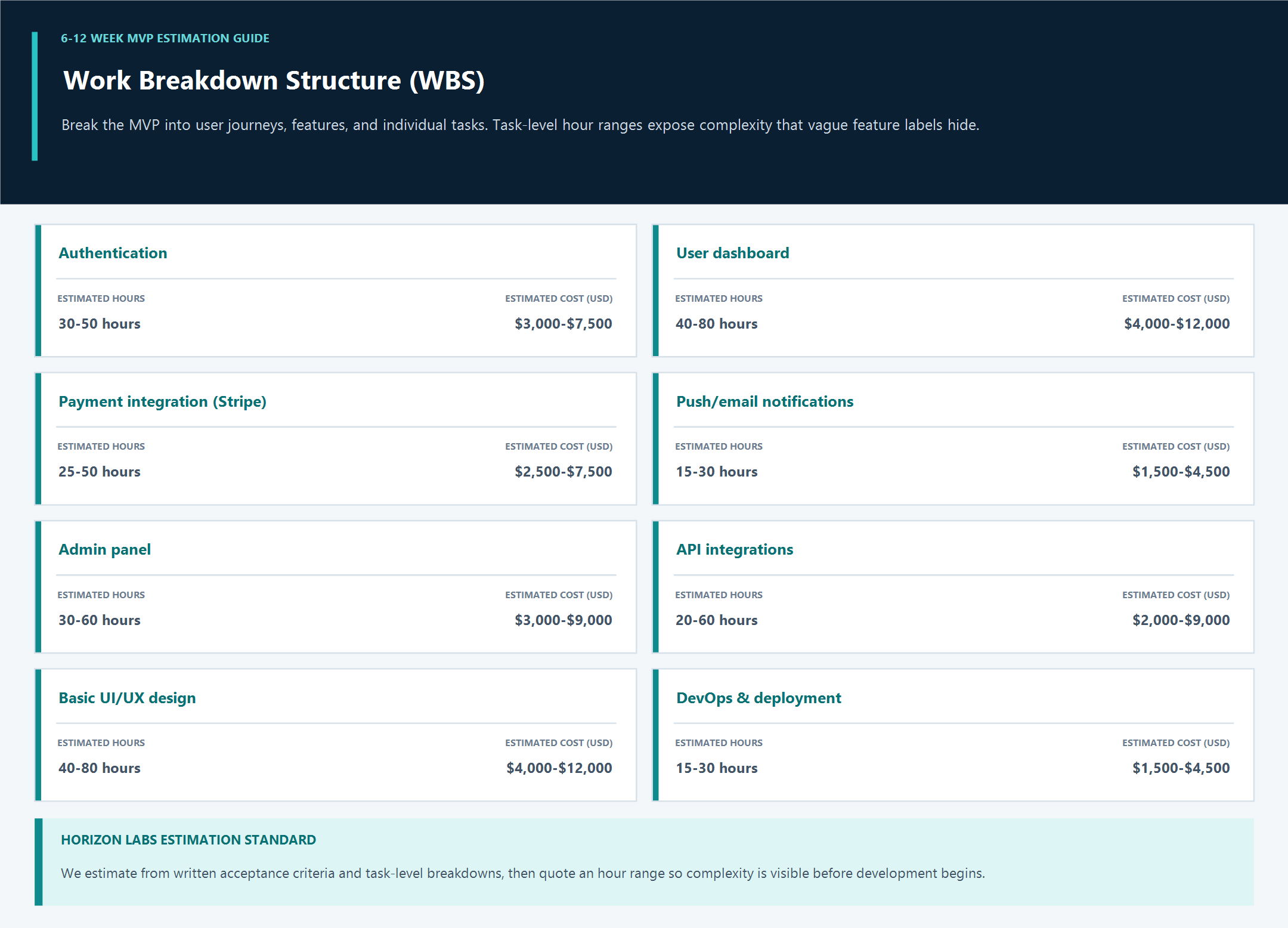
Best for: Initial scoping conversations, vendor quote evaluation, budget approval.
Watch out for: The missing-tasks problem (more on that below). Every WBS underestimates by default because you only list what you can think of.
For each task, gather three numbers: Optimistic (O), Most Likely (M), and Pessimistic (P). Then apply the PERT weighted average: (O + 4M + P) / 6.
Example: A payment integration might be 20 hours optimistic, 35 hours most likely, 60 hours pessimistic. PERT estimate = (20 + 140 + 60) / 6 = 36.7 hours.
This technique explicitly models uncertainty, which makes it valuable for MVPs where nobody has built this exact product before.
Best for: Features with high technical uncertainty, third-party integration work.
Watch out for: Teams tend to anchor the optimistic number too low and the pessimistic number not high enough, which defeats the purpose.
Instead of saying “12 days,” say “10–15 days.” Practitioner Vadim Kravchenko advocates strongly for this approach, warning that you should emphasize the upper bound because “stakeholders only hear the smaller number.”
This is the simplest and most honest way to communicate estimates to non-technical stakeholders.
Best for: Communicating with founders, investors, and business stakeholders.
Watch out for: If you give a range of “8–12 weeks,” everyone will plan around 8 weeks and be surprised at 12. State the upper bound first.
A story point is a unit of relative effort that considers complexity, risk, and volume of work rather than specific hours. Teams use planning poker: each engineer privately selects a Fibonacci number (1, 2, 3, 5, 8, 13), then all reveal simultaneously. Disagreements surface hidden assumptions.
Best for: Sprint-level planning once the team is actively building.
Watch out for: Story points are nearly useless for initial budget and timeline scoping with a client. They’re a team-internal tool, not a contract input.
Label each feature XS, S, M, L, or XL. Map each size to an hour range (XS = 4–8h, S = 8–16h, M = 16–40h, L = 40–80h, XL = 80–160h). Roll up the totals.
Best for: Early-stage scoping when requirements are still vague. Useful during a first conversation about what your MVP should include.
Watch out for: Low precision. Fine for “is this a $30K project or a $150K project?” but not for milestone-level planning.
Managers often default to person-weeks because they convert easily to dates. “That’s a 3-person-week feature” sounds concrete. But the conversion from person-weeks to calendar time is deceptively broken. Communication overhead, context switching, and dependencies mean that 3 person-weeks of effort rarely completes in one calendar week with three people.
Best for: Rough capacity planning.
Watch out for: Almost always produces optimistic timelines because it ignores overhead.
Understanding the failure modes is half the battle when estimating engineering effort for a 6–12 week MVP.
Humans are structurally incapable of accurately predicting how long novel work will take. Daniel Kahneman called this the planning fallacy: we plan based on best-case scenarios and ignore base rates from similar past projects.
Software engineer Jesse Squires captured this perfectly with a joke that went viral (3,000+ retweets): convert your engineering estimate from weeks to Celsius, then to Fahrenheit. Three weeks becomes 3°C, which becomes 37.4°F, which becomes 37.4 weeks. It resonated because it matches what actually happens.
Practitioners on DEV Community have dissected why developers consistently underestimate. Luke Garrigan identifies the specific drivers: developers want to impress, groupthink during sprint planning amplifies underestimation, and pressure from leadership further compresses numbers. He references McConnell’s recommendation to “understand your margins. If you’re estimating something completely new, you might need a 100% or even 400% factor.”
After a decade of analyzing completed project hour reports, practitioner PJ Srivastava concluded: “when a task is underestimated due to a lack of knowledge or experience, it is usually not by 20% or 50%, but by a multiple of 2, 3, 4, or even higher.” He recommends tripling initial estimates for genuinely new work.
Agile pioneer Alistair Cockburn independently discovered that multiplying by π (3.14) has “an almost magical effect at correcting initial estimates.” Whether it’s 3x or π, the direction is the same: double-digit percentage buffers are insufficient for novel work.
This creates a real tension. Most agency guides recommend a 15–25% contingency buffer. Experienced practitioners say the actual correction factor for new work is 200–300%. The right answer depends on how much of the work is truly novel versus familiar territory the team has built before. More on this in the framework section below.
Srivastava’s registration-form example illustrates this brilliantly. What seems like a simple form (a few text boxes and a submit button) actually includes: character limits, input masks, client-side validation, server-side validation, error messages, session handling, email confirmation flow, password complexity rules, CAPTCHA, accessibility compliance, and more. Each “simple” feature hides 3–5x the tasks you initially imagine.
This is why estimation without written acceptance criteria is theater. You can’t estimate what you haven’t defined. Before assigning hours to any feature, you need testable conditions that define “done.” What happens when the user enters invalid input? What does the error state look like? What edge cases exist?
Not all engineering hours are coding hours. Vadim Kravchenko uses a practical multiplier: “raw coding hours × 1.5 is my quick multiplier” to account for standups, code review, environment issues, CI/CD pipeline setup, and context switching. He recommends tracking it for one sprint to calibrate your own number.
For a 6–12 week MVP, this overhead is proportionally higher than for a mature product. The team is setting up infrastructure, establishing conventions, and making architectural decisions for the first time. A 1.5x multiplier is a reasonable starting point.
This is the part no single page in the search results covers well. Here’s a repeatable process for estimating engineering effort for a 6–12 week MVP, whether you’re doing it yourself or evaluating a vendor’s proposal.
Write one sentence: “A [user type] can [do the core action] and [get the core outcome].”
Examples:
Everything that doesn’t serve this sentence is a candidate for V2. Ruthless scoping here saves weeks of effort downstream.
List every feature required for that journey. For each feature:
This step is where most estimation processes fail. Teams skip straight from “list features” to “assign hours” without defining what each feature actually entails. The acceptance criteria are what make an estimate defensible.
For each feature, estimate optimistic, most likely, and pessimistic hours. Use the PERT formula to calculate weighted averages. Sum them up.
If requirements are still too vague for PERT, use T-shirt sizing to get a ballpark and flag which features need more definition before a real estimate is possible.
Multiply your raw hours by 1.5x to account for meetings, code review, DevOps configuration, testing, and context switching. This is Kravchenko’s “meeting tax,” and it’s real. A 400-hour raw estimate becomes 600 hours of actual calendar capacity needed.
This is where the tripling rule and the 15–25% buffer need to be reconciled.
DevTimate recommends the 15–25% range explicitly, but that assumes the earlier steps were done thoroughly. Skip the WBS and acceptance criteria, and you’ll need the 3x multiplier.
Invest 1–2 weeks in a focused discovery sprint before committing to the full build budget. The team explores technical unknowns, builds quick proofs of concept for risky integrations, and produces detailed specs.
After discovery, re-estimate. This is where the cone of uncertainty shrinks from 4x to roughly ±25%, and where you can confidently commit to a timeline and cost with a client, investor, or board. Teams that want to get a realistic scoping conversation started before committing to a full build should prioritize this step.
Break the total estimate into two-week deliverables. Each milestone should produce something demonstrable: a working login flow, a functional checkout, a deployed staging environment.
This serves two purposes. First, it creates natural checkpoints where you can compare actual progress against the estimate and catch drift early. Second, it gives stakeholders visible progress, which reduces the pressure that leads to scope changes.
Knowing what to exclude is as important as knowing what to estimate. Based on GroovyWeb’s 2026 MVP blueprint, here’s a practical starting point:
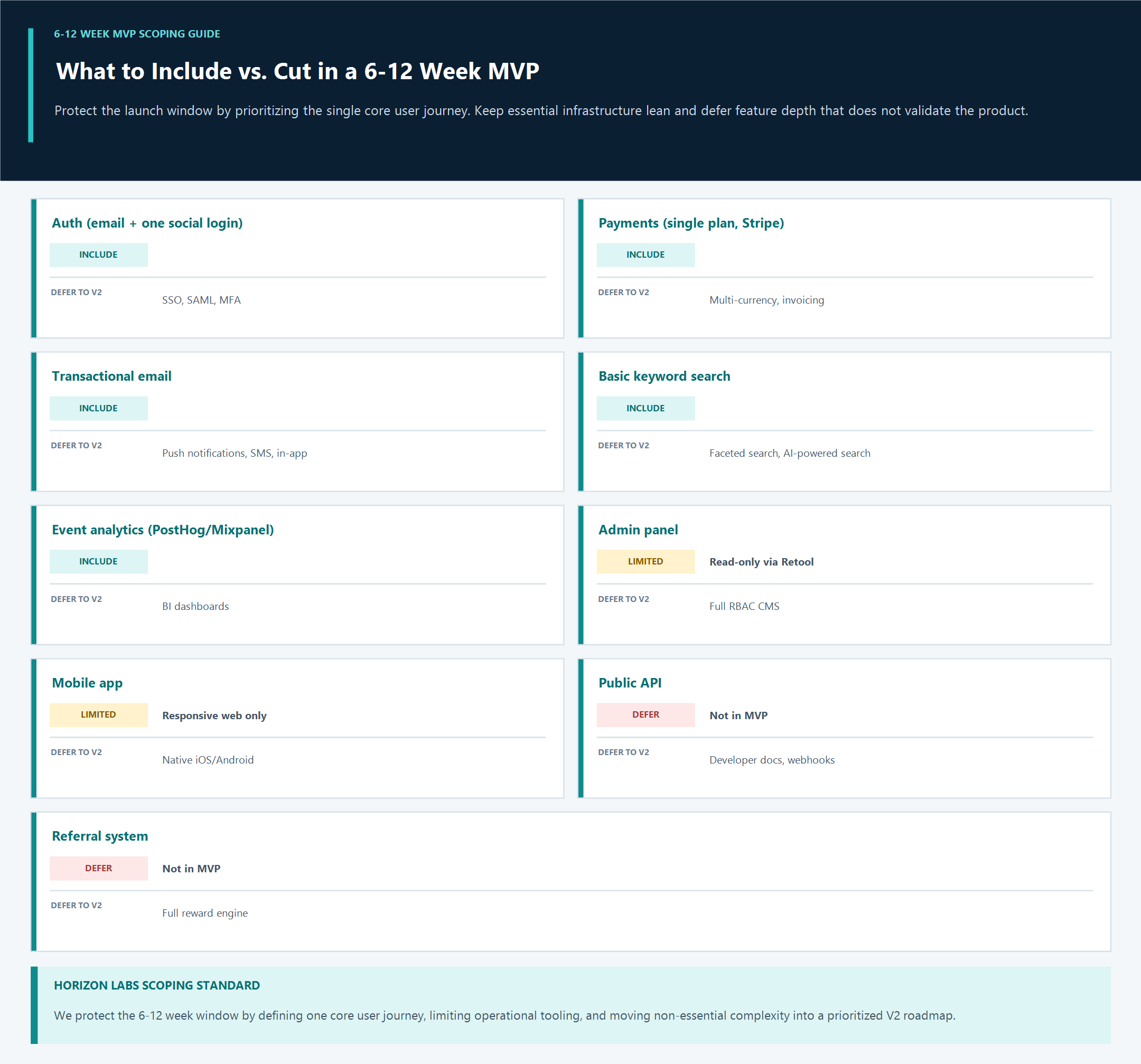
The MoSCoW framework (Must have, Should have, Could have, Won’t have) is the standard tool for making these decisions. Everything in your core user journey is a Must. Everything else gets debated.
For marketplace MVPs specifically, the calculus shifts. You need enough trust and transaction infrastructure to get both sides of the market transacting. Sharetribe-based marketplace builds can accelerate this because the core listing, search, booking, and payment infrastructure comes out of the box, leaving custom effort focused on what makes your marketplace unique.
Real numbers, synthesized from multiple 2025/2026 sources.

(Source: Intigate, MVP Development Cost for Startups 2026)
Hidden costs like maintenance, hosting, third-party tools, and post-launch iterations can add 15–25% to your initial budget if not planned upfront.
The biggest hidden cost is the one that’s most obvious in hindsight: post-launch iteration. The entire point of an MVP is to learn from real users and iterate. If your estimate only covers launch, you’ve budgeted for the experiment but not for acting on the results. Plan for at least 4–8 weeks of post-launch iteration budget.
Other commonly missed line items:
To see how these costs play out in real projects, browse delivered MVP case studies to calibrate expectations.
If you’re evaluating proposals from agencies or freelancers, these warning signs suggest the estimate won’t hold:
No discovery phase. If the vendor jumps straight from a 30-minute call to a fixed quote, the estimate is a guess wearing a suit. Credible firms run discovery sprints or at minimum conduct a detailed scoping exercise before committing to numbers.
Single-point estimates. “This will take 10 weeks and cost $75,000.” No range, no uncertainty acknowledgment, no contingency. Either the vendor is overcharging to hide their uncertainty, or they’ll come back with change orders later.
No acceptance criteria. If the proposal lists features without defining what “done” means for each one, you’re heading toward scope disputes.
No contingency buffer. A proposal that accounts for exactly 100% of the work and 0% of the unexpected is fiction.
No milestone breakdown. A single delivery date 12 weeks out with no intermediate checkpoints means you won’t know the project is off track until it’s too late.
Hourly rate dramatically below market. If you’re seeing $15–$25/hour for senior full-stack development, the “senior” part is aspirational. You’ll pay the difference in rework, communication overhead, and missed deadlines.
Estimating engineering effort for a 6–12 week MVP is not about achieving false precision. It’s about narrowing uncertainty to a range you can make decisions around. The best estimates share a few qualities: they’re built on written acceptance criteria, they use ranges instead of single numbers, they account for overhead and unknowns with explicit multipliers, and they get revised after discovery work reduces the cone of uncertainty.
Whether you’re estimating internally or evaluating an agency’s proposal, the framework above gives you a structure to spot gaps, ask better questions, and avoid the most common traps. The math matters, but so does the discipline of defining scope clearly before anyone writes a line of code.
If you’re ready to move from estimation to execution, request a free project estimate to see how a milestone-based process with acceptance criteria, risk annotation, and explicit trade-offs works in practice.
At the very start, before any discovery work, estimates carry roughly a 4x uncertainty factor in both directions. After a 1–2 week discovery sprint with defined acceptance criteria, that range typically narrows to ±25%. No estimate is ever perfectly accurate, but the goal is to get close enough to make sound budget and timeline decisions.
For initial scoping and budget conversations, use hours (or hour ranges). Story points are useful once a team is actively sprinting and needs to measure relative complexity across tasks, but they don’t translate to dollars or calendar weeks in a way that’s useful for project planning with stakeholders.
It depends on novelty. For teams building in a familiar domain with proven technology, 15–25% is standard. For teams tackling new technology, unfamiliar integrations, or a first-time collaboration, 30–50% is more realistic. If nearly everything about the project is new, experienced practitioners recommend doubling or tripling the initial estimate rather than adding a percentage buffer.
Effort estimation measures work in person-hours or person-weeks. Cost estimation multiplies effort by the team’s hourly or weekly rate. Calendar-time estimation converts effort into a delivery schedule based on team size, availability, and overhead. All three numbers are related but distinct, and conflating them is one of the most common sources of misalignment between founders and development teams.
You can evaluate an estimate without being technical by checking for the right structure: a feature-level breakdown, acceptance criteria for each feature, ranged (not single-point) numbers, an overhead multiplier, a contingency buffer, and milestone checkpoints. If a vendor’s proposal has all of these, the estimate is likely grounded. If it’s missing several, ask questions.
For a simple SaaS product with authentication, one core feature, and basic CRUD operations, expect $8,000–$40,000 and 4–10 weeks with a small team. The wide range reflects differences in design complexity, third-party integrations, and geographic rate differences among development teams.
Because the cone of uncertainty makes pre-discovery estimates unreliable by a factor of 4x. A discovery sprint (typically 1–2 weeks) lets the team investigate technical unknowns, prototype risky features, and write detailed specifications. The resulting estimate is dramatically more accurate and protects both the client and the agency from scope surprises.
If your feature list exceeds 15–20 distinct features, requires native mobile apps on both platforms, involves AI/ML model training, or needs more than three complex third-party integrations, it’s likely too large for a 12-week window. The fix isn’t to compress the timeline. It’s to cut scope back to the single core user journey and defer everything else to V2.

Compare 12 vetted MVP development company options with 2026 pricing, Clutch reviews, and timelines. Typically $30K–$60K in 8–14 weeks. Choose the right partner.

Your sample deliverables timeline for a 12 week mvp, week-by-week checklist for discovery, design, dev, QA, and launch. Use it to plan and vet proposals.

Learn how to build a Minimum Viable Product (MVP) fast and cheap with this guide for startup founders, plus tips from Horizon Labs’ YC-alum team.
Tell us what you're building. After an intro call with our founders, you'll hear back within 72 business hours: a written scope with an hour range and a hard ceiling, or the questions we need answered first.