.webp)

Demo MVP Guide 2026: Costs, Timelines + 15 Examples
Build a Demo MVP in 6–12 weeks. Explore 15 examples, 2026 costs, build options, and a readiness checklist. Avoid pitfalls and wow investors—start now.
A demo MVP, or Minimum Viable Product, is a focused version of your product with just enough features to be usable by early customers who can then provide feedback for future development. For startups and small businesses, especially those born from accelerators like Y Combinator, building an effective demo MVP is the most critical first step. It’s not just about writing code. It’s about de risking your spending, validating your core idea with real users, and creating a compelling asset for investor conversations, all without spending months in development.
Demo MVP vs Prototype: Clarifying Scope and Purpose
Founders often confuse a demo MVP with a prototype, but they serve very different goals. Understanding the distinction is key to managing your budget and timeline effectively.
Prototype: A prototype is a visual mockup or a wireframe, often created with tools like Figma or InVision. Its main purpose is to explore the user interface (UI) and user experience (UX). Prototypes are typically not functional. You can click around, but there is no real backend logic, database, or working functionality. They answer the question, “What could this look like?”
Demo MVP: A demo MVP is a working piece of software. While limited in scope, its core features function as intended. It has a real backend, processes data, and provides genuine value to a user. A demo MVP answers the question, “Does this solve the core problem?” This is the version you use to gather meaningful user feedback and demonstrate traction to investors. For instance, a fintech demo MVP might process a single type of transaction perfectly, like Bloom’s paper-trading MVP, while a full product would handle dozens.
Build Approaches for a Demo MVP: No Code vs Traditional, In House vs Partner
Once you’ve defined your scope, you need to decide how to build your demo MVP. There are four primary paths, each with its own trade offs.
Build Method
No Code or Low Code: Platforms like Bubble or Webflow are excellent for simple applications, marketplaces, or content driven sites. They offer incredible speed for initial versions. However, they can be limiting for custom logic, complex transaction flows, or long term scalability. For example, RareWaters migrated from WordPress to a Sharetribe marketplace in under three months to support season passes, gift cards, and dynamic pricing.
Traditional Code: Writing code using frameworks like React, Node.js, and Python provides complete control and unlimited potential for customization and scale. This is necessary for products with unique features, AI integrations, or specific compliance needs like HIPAA. A good example is Patcom Medical’s healthcare training marketplace, which combined Sharetribe with custom React/Node services to handle verification and commission logic.
Team Structure
In House Team: If you have a technical cofounder or an existing engineering team, building in house gives you maximum control. The challenge is often speed and capacity. Your team might be busy with an existing product, or you may lack senior talent with specific expertise in areas like DevOps or AI.
Agency Partner: Partnering with a development agency can be the fastest way to a high quality demo MVP. A good partner brings senior expertise, proven processes, and predictable timelines. For example, firms like Horizon Labs offer a blended model with US leadership and a senior offshore team, providing cost effective access to top tier talent for building your demo MVP. This route allows founders to focus on product vision and go to market strategy. For instance, Arketa leveled up its DevOps and Kubernetes pipelines to scale from MVP to production.
2026 Costs and Timelines for a Demo MVP
Budget and timeline are the two biggest concerns for any founder. For a demo MVP, a realistic range helps in planning and fundraising.
Timelines: A well defined demo MVP can typically be built in 6 to 12 weeks. This timeframe is a sweet spot. It’s fast enough to maintain momentum and get to market quickly but long enough to build a quality, stable product. More than 60 MVPs have been shipped since 2019 using this agile approach.
Costs: The cost varies significantly based on complexity and the build approach.
No Code: A simple no code demo MVP might cost between $5,000 and $15,000.
Custom Coded: A custom coded demo MVP usually starts around $10,000 and can go up significantly depending on features. Reputable agencies often have minimum project sizes, for example, starting at $5,000, with average hourly rates for senior engineers ranging from $150 to $249 per hour.
Demo MVP Readiness Checklist: Quality, Communication, and IP
Quality and Stability
Your demo MVP must be reliable within its limited feature set. The core user journey should be bug free. A great practice is to partner with a firm that provides a code warranty. For example, Horizon Labs offers a six month warranty, fixing any defects found within the original scope at no extra charge.
Communication and Pitch
Can you explain what your product does and the problem it solves in 30 seconds? Your pitch should be as polished as your product. Prepare a script for demos and anticipate common questions from users and investors.
Intellectual Property (IP)
You must own the code and all intellectual property associated with your product. When working with contractors or agencies, ensure your agreement clearly states that all IP is transferred to your company upon completion and payment. This is a non negotiable standard for professional development partners. If an agency doesn’t guarantee your IP ownership, it’s a major red flag.
Top 15 Demo MVP Examples to Inspire Your Launch
Seeing theory put into practice is essential for understanding how to balance speed with quality during early-stage development. This curated selection of industry-leading examples demonstrates how top product studios distill complex ideas into functional, high-impact prototypes. By studying these diverse approaches, you can identify the specific strategies and technical frameworks that will best support your own product’s unique value proposition.
1. Horizon Labs
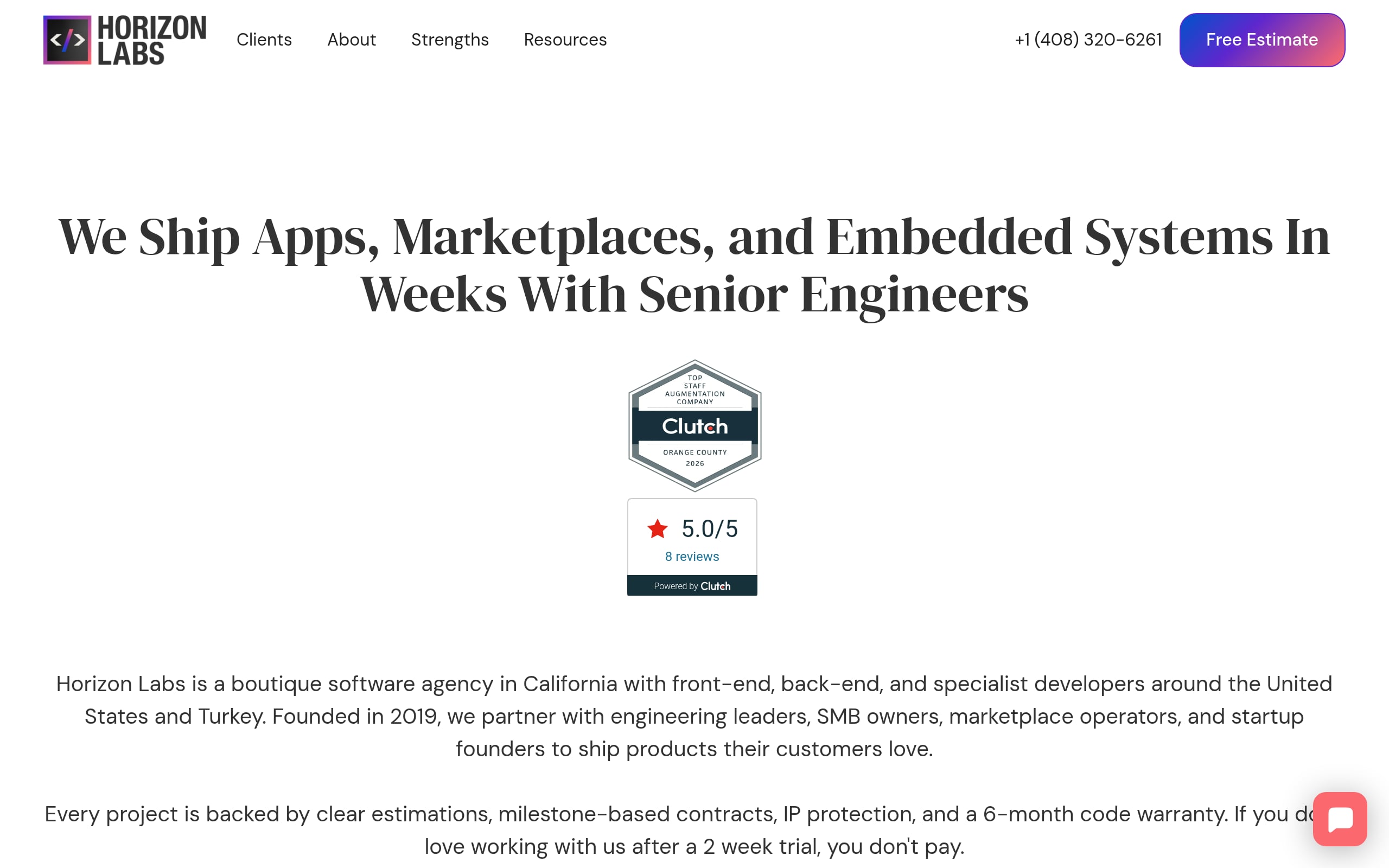
Founded by YC alumni and former VCs, Horizon Labs is built for founders racing from raw concept to investor-ready product. In 8 to 12 weeks, they pair US-based product leadership with senior engineers to ship demos that look great and withstand technical diligence. The result: polished MVPs that balance sharp UX with battle-tested architecture.
Why it stands out
Launch speed: idea to functional market launch in 8 to 12 weeks.
Technical depth: LLM integrations, Sharetribe marketplaces, complex IoT firmware.
Investor-grade design: high-fidelity UI/UX tailored to tier-1 VC expectations.
Reliability: six-month code warranty; milestone-based contracts; full IP protection.
Best for: Seed-stage founders building SaaS or AI-powered products who need a high-polish, diligence-ready demo for near-term fundraising.
Quick facts: Location/time-zone: Irvine, CA (PT/Turkey hybrid); Pricing/min: $10,000 engagement; Stack: React, Next.js, Flutter, Node.js; Reviews/clients: YC-backed Flair Labs, Arketa; Delivery model: Weekly sprint demos; direct Slack access to founders.
2. LowCode Agency
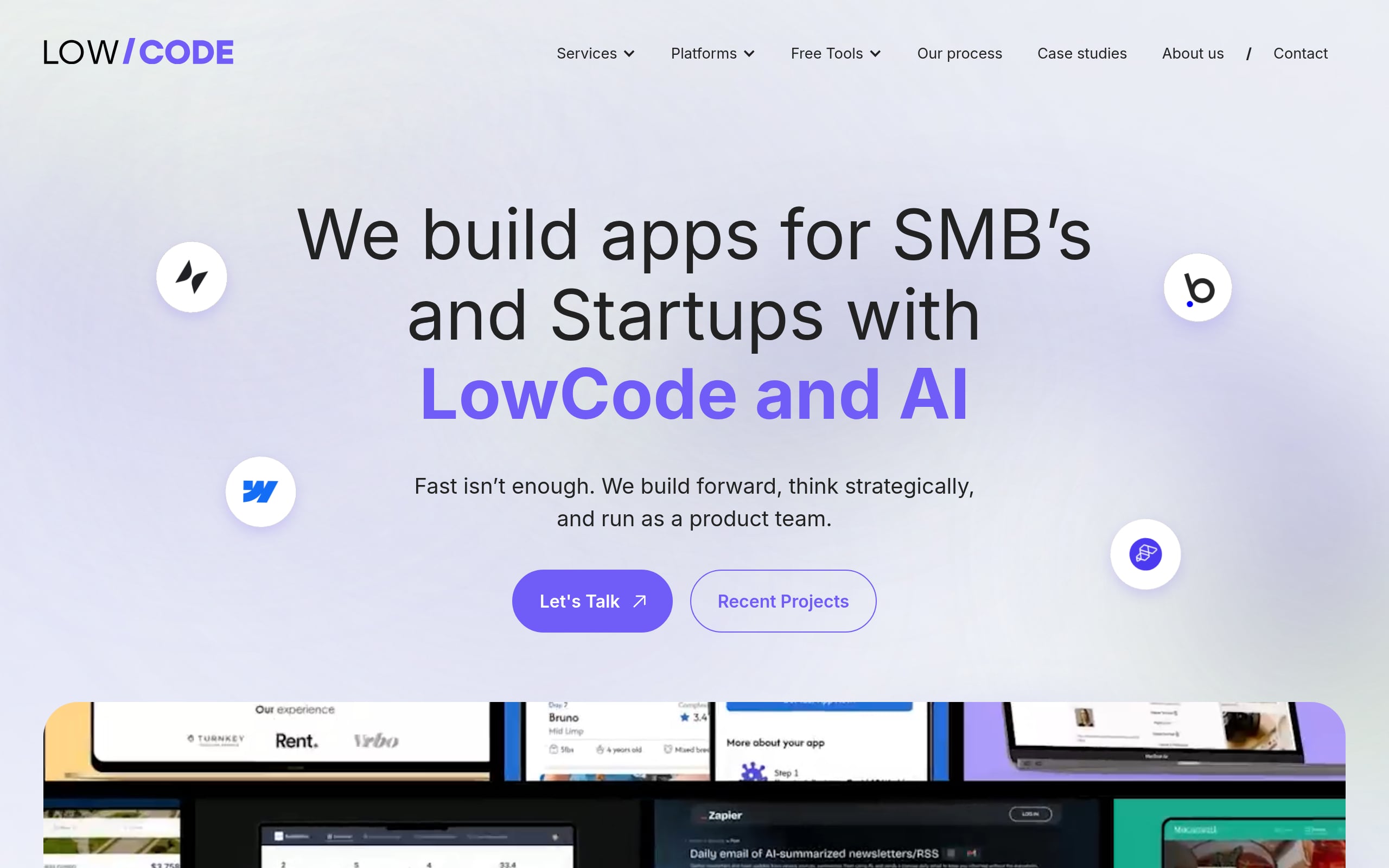
LowCode Agency compresses timelines by building on Glide, Bubble, and similar platforms, prioritizing business logic and UX over heavy custom backends. The approach consistently produces investor-ready demos and internal tools in weeks, not months, giving teams proof of traction while keeping budgets tight and momentum high.
Why it stands out
2 to 6 week MVPs: dramatically reduced time-to-market.
Advanced builds: AI features, two-sided marketplaces, IoT dashboards that scale to 10,000+ users.
Proven track record: 300+ completed projects with rigorous QA and warranties.
Lean tech strategy: performance and reliability tuned for live pitches and demos.
Best for: Founders and innovation teams who need a sharp, working demo (or live alpha) fast to test demand or pitch investors.
Quick facts: Location/time-zone: US-based, global overlap; Pricing/min: $5k to $15k; Stack: Glide, Bubble, FlutterFlow, Airtable, Zapier; Reviews/clients: American Express, 300+ startups; Delivery model: Agile sprints, weekly demos, dedicated PM, Slack comms.
3. Thoughtbot
Thoughtbot popularized disciplined, design-led MVPs that cut through uncertainty. Their Product Design Sprints turn months of discovery into a single high-intensity week, then Rails-forward engineering ships clean, maintainable codebases that validate fast and scale smoothly, ideal for complex ideas with real stakes.
Why it stands out
Rapid validation: 5-day sprints yield user-tested prototypes and a focused roadmap.
Technical excellence: Rails leadership with emerging AI orchestration (e.g., Active Agent, Superglue).
Quality: Test-driven development for near-zero tech debt on handoff.
Market impact: Helped Oromoon pair MVP with a marketing lander to spark early audience growth.
Best for: Teams prioritizing speed, product rigor, and long-term maintainability over rock-bottom cost.
Quick facts: Location/time-zone: USA-based, remote-first; Pricing/min: $10k (Sprint), $50k to $150k+ (MVP); Stack: Rails, React, AI orchestration; Reviews/clients: Merck, Oromoon; Delivery model: Weekly Agile iterations via Slack/Trello with a senior PM lead.
4. Designli
Designli blends product strategy with swift execution to turn founder vision into investor-ready MVPs. Their Solution Lab locks scope around what truly matters, and then an experienced team moves from wireframes to code with a relentless focus on UX polish, velocity, and budget discipline.
Why it stands out
Rapid delivery: concept to V1 in 12 to 16 weeks.
Versatile tech: React Native, Node.js, plus AI/ML and IoT for data-rich products.
Fundraising results: client MVPs have raised tens of millions post-launch.
Enterprise sensibility: CI/CD, dedicated QA, HIPAA/fintech-ready security.
Best for: Early-stage founders and intrapreneurs who need a high-performance MVP to raise or validate within a few months.
Quick facts: Location/time-zone: Greenville, SC (US-managed); Pricing/min: $5k+ discovery; $40k to $100k+ MVPs; Stack: React, Node.js, Ruby on Rails; Reviews/clients: 4.9/5 on Clutch (100+ reviews); Delivery model: Weekly sprint reviews; daily Slack/Jira transparency.
5. Rootstrap
Rootstrap’s signature Roadmapping phase zeros in on core value and trims bloat before a line of code is written. From there, they move quickly to prototypes and production-grade MVPs, giving founders investor-ready artifacts and a credible plan to scale.
Why it stands out
Fast discovery: clickable prototypes and technical blueprints in 2 to 4 weeks; clients have raised $500M+.
Deep expertise: AI/ML, high-traffic marketplaces, Rails/Node ecosystems.
Delivery quality: CI/CD, automated testing, weekly sprints for reliability.
Scale stories: helped grow MasterClass from inception to a global platform.
Best for: High-growth startups that need a fundable MVP and a scale-ready foundation inside a 10 to 12 week window.
Quick facts: Location/time-zone: Los Angeles with South America overlap; Pricing/min: $50k to $150k+; Stack: Ruby on Rails, React Native, Python; Reviews/clients: Google, Spotify (4.8+ Clutch); Delivery model: Nearshore hybrid with dedicated PMs/architects.
6. F22 Labs
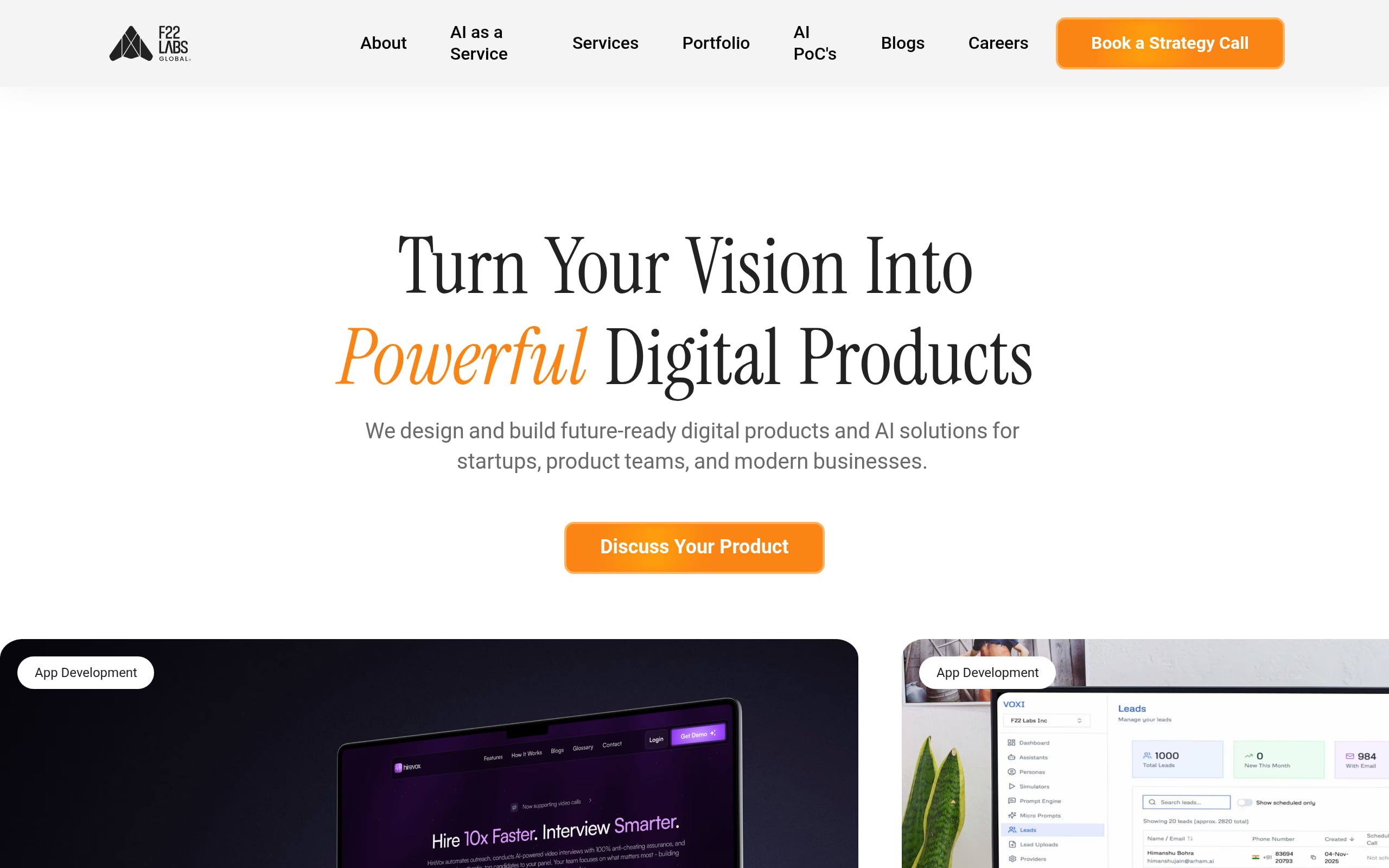
F22 Labs operates like a Zero-to-One accelerator, moving founders from concept to PMF track with speed. They emphasize MVPs that don’t need rewrites: clean architectures, tight scopes, and demos that impress investors while standing up to real-world traffic.
Why it stands out
45–60 day launches: investor-ready MVPs in two months.
Engineering rigor: AI SaaS, real-time marketplaces, scalable cloud patterns.
Quality assurance: modern CI/CD, daily builds, Sprint Zero discipline.
Scale without rewrites: “throw-away-code-free” approach for the first 10,000 users.
Best for: Pre-seed teams validating fintech or SaaS theses on tight two-month timelines.
Quick facts: Location/time-zone: Chennai, India with US/EU overlap; Pricing/min: $20k to $50k; Stack: React, Node.js, Python, AWS; Reviews/clients: 100+ launches, YC alumni; Delivery model: Hybrid management, Scrum Masters, transparent Slack/Jira cadence.
7. Digital Scientists
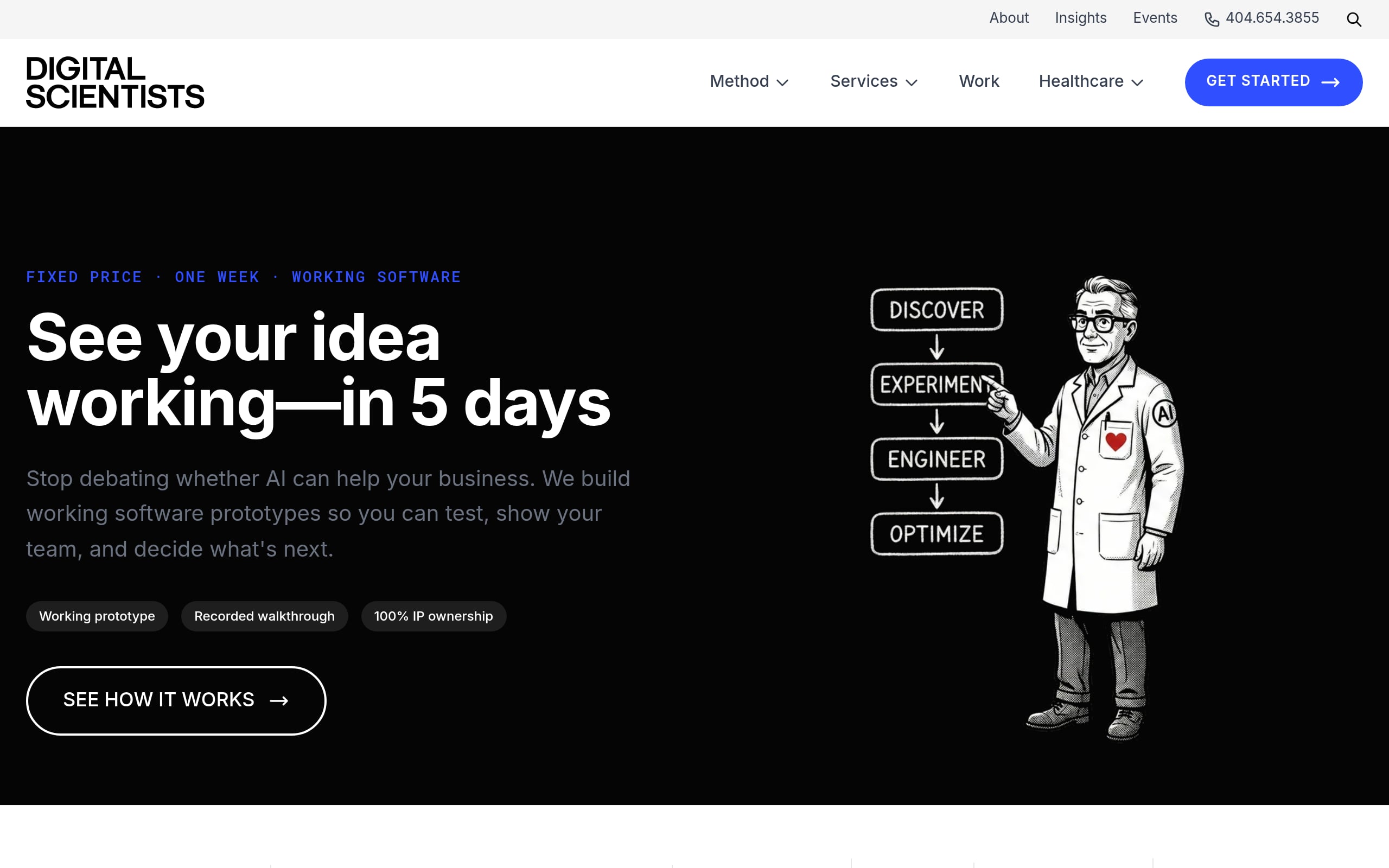
Digital Scientists champions a Discovery-First ethos to de-risk complex bets before building. Their sweet spot spans health, IoT, and data-heavy SaaS, domains where disciplined research, prototyping, and compliance are non-negotiable for investor confidence and pilot wins.
Why it stands out
Defined timelines: 4-week discoveries and 12-week MVPs for faster market entry.
Technical breadth: AI/ML, IoT sensor integration, complex API orchestration.
Compliance-minded: HIPAA and SOC2 sensibility for regulated sectors.
Design-led builds: consumer-grade UX that accelerates funding and pilots.
Best for: Series A-ready startups or enterprise innovation teams in regulated spaces that need a functional, high-fidelity MVP on deadline.
Quick facts: Location/time-zone: Georgia, US Eastern; Pricing/min: $75k to $200k MVPs; Stack: React, Node.js, Python, AWS; Reviews/clients: Humana, Siemens; Delivery model: 100% onshore, dedicated PM, weekly reviews, full Agile cadence.
8. Purrweb
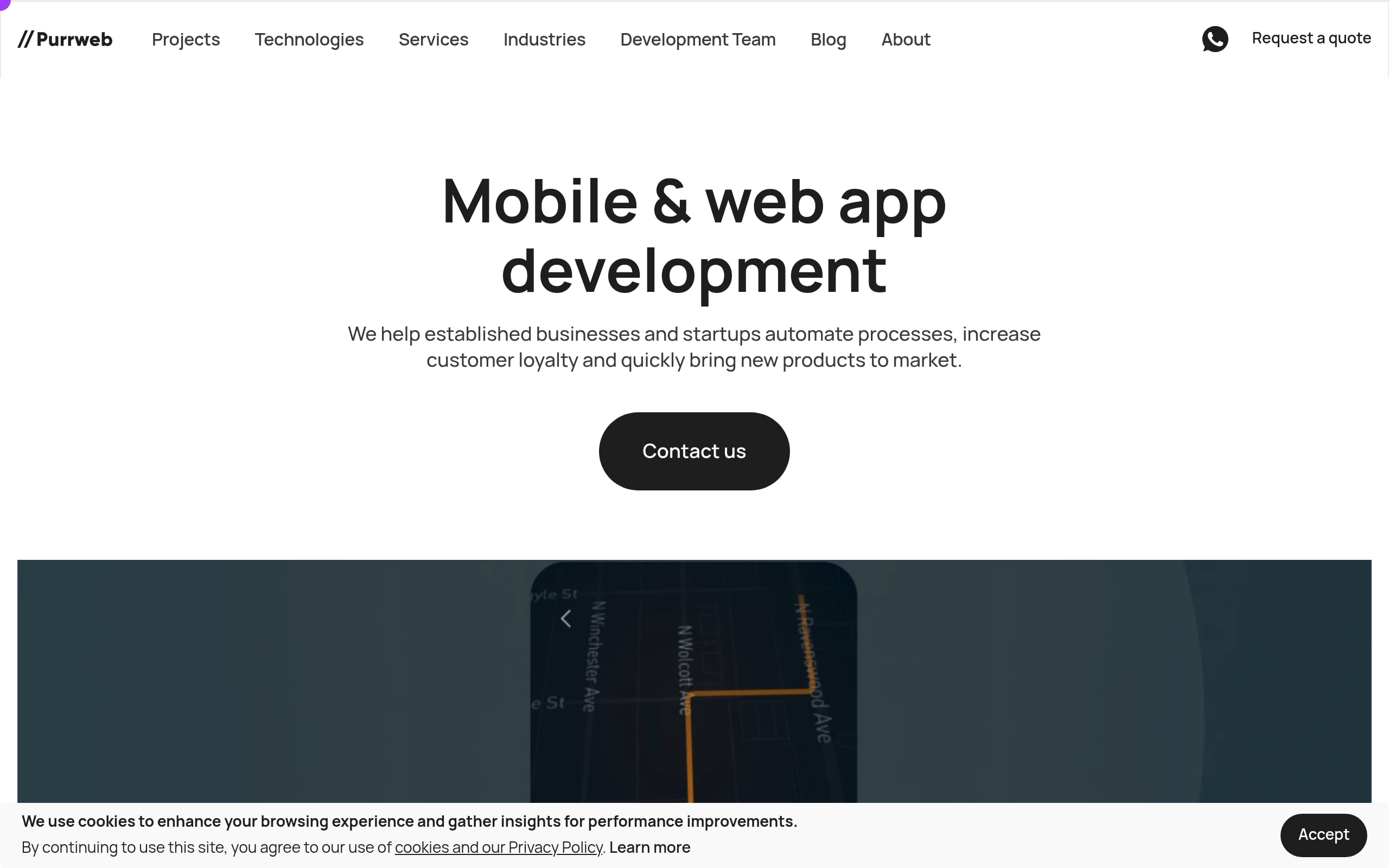
Purrweb is unapologetically design-first, shipping beautiful, investor-ready MVPs in exactly three months. Their discipline around must-have features keeps budgets tight and momentum high, while UI polish helps founders win meetings and convert on fundraising.
Why it stands out
90-day MVPs: integrated design, development, and QA.
Fundraising catalyst: 300+ launched MVPs; many went on to Series A/B.
Sector strength: fintech, HIPAA-sensitive healthcare, and IoT complexity.
Post-launch assurance: rigorous testing and a standard warranty.
Best for: Pre-seed and Seed founders who need a visually stunning, pitch-perfect MVP inside 12 weeks.
Quick facts: Location/time-zone: UAE-based, global overlap; Pricing/min: $25k to $50k; Stack: React Native, Node.js, React.js; Reviews/clients: 4.9+ Clutch (e.g., Brebebe); Delivery model: Dedicated PM, weekly demos, Slack updates, hybrid offshore/nearshore.
9. Stormotion
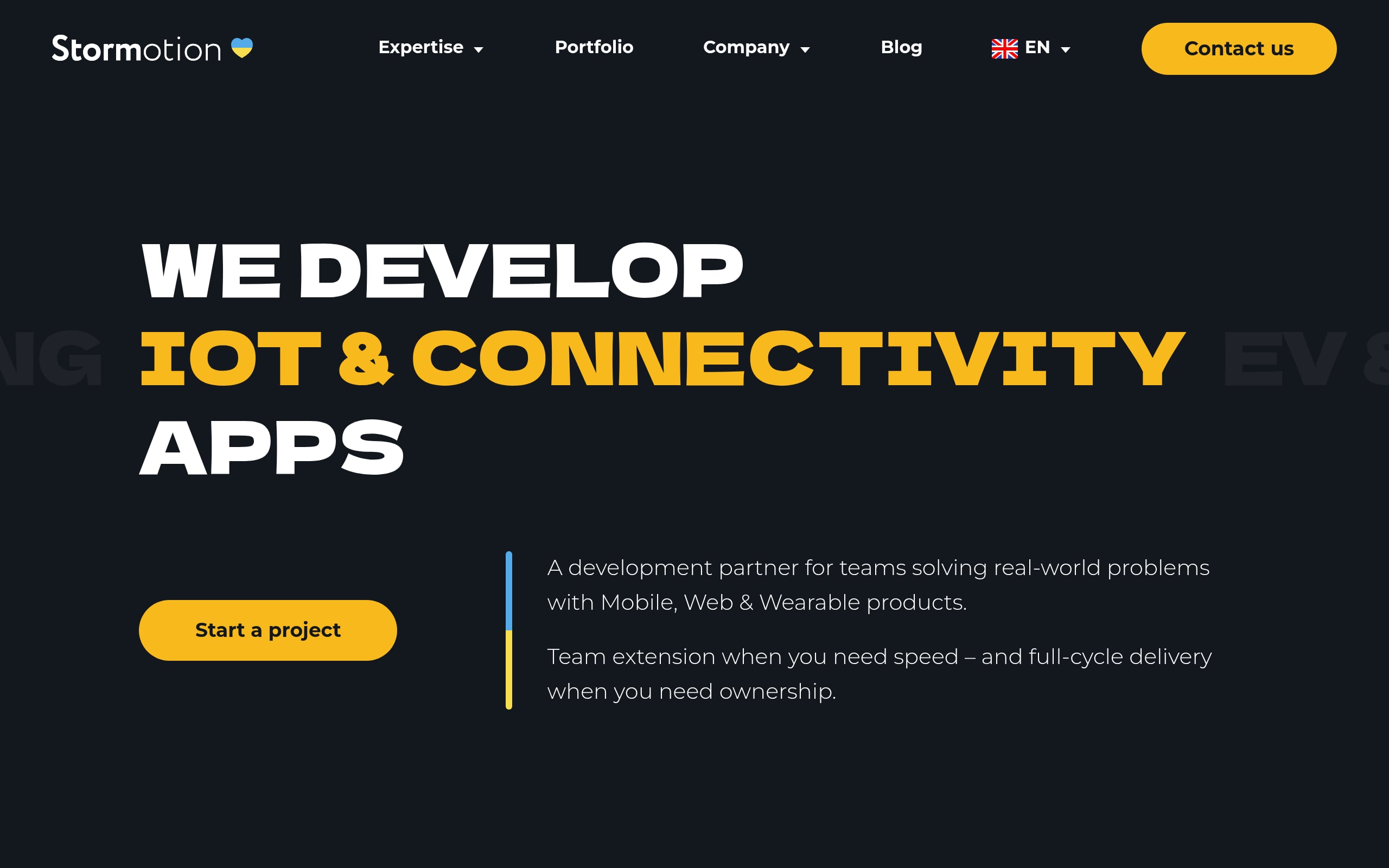
Stormotion builds market-ready MVPs with a mobile and IoT edge, bridging BLE devices, wearables, and intuitive apps. Their lean playbook gets complex products into the wild within a quarter, giving founders credible demos for pilots, partnerships, and early sales.
Why it stands out
Rapid entry: 12 to 16 weeks from discovery to App Store/Google Play.
IoT fluency: BLE and real-time telemetry for e-scooters and industrial monitors.
Engineering hygiene: 81% average QA coverage; CI/CD; cost-efficient React Native.
Production-minded: 95% of MVPs advance to durable, scalable products.
Best for: Early-stage founders and hardware teams in Health or e-Mobility that need robust prototypes with device integrations.
Quick facts: Location/time-zone: Tallinn/Ukraine (GMT+2); Pricing/min: $30k to $60k (floor $10k); Stack: React Native, Node.js, AWS; Reviews/clients: 5.0 Clutch; Force USA, Deftpower; Delivery model: Standalone team, weekly sprints, transparent Slack.
10. Upsilon
Upsilon is engineered for early-stage velocity: clear hypotheses, lean scope, and a build that’s investor-ready in under 90 days. The team blends pragmatic product thinking with strong Python/React chops so founders can validate and scale without accruing debt.
Why it stands out
40–60 business days: full-featured MVPs on tight clocks.
Investor wins: portfolio includes nine-figure outcomes and notable exits (e.g., LiveArt).
Advanced engineering: Python/Django backends, React frontends, Generative AI.
Standardized quality: CI/CD, bi-weekly demos, post-launch warranty.
Best for: SaaS, Fintech, or Logistics founders chasing seed/Series A with a scale-ready MVP inside three months.
Quick facts: Location/time-zone: US-headquartered, global overlap; Pricing/min: $20k to $65k; Stack: Python, Node.js, React, AI; Reviews/clients: 4.9/5 Clutch; Delivery model: Dedicated squads (PM, UX, QA) acting as an extension of your team.
11. Altar.io
Altar.io fuses ex-founder product sensibility with top-tier engineering to turn big visions into crisp, investor-ready MVPs. In 10 to 14 weeks, they ship focused builds with the UX clarity and architectural integrity that make fundraising and early scale less risky.
Why it stands out
Predictable speed: 10 to 14 week MVPs that hit key fundraising or pilot windows.
Complex domains: FinTech, HealthTech, and AI-driven SaaS on cloud-native stacks.
Repeatable playbook: a 10-step process from story mapping to lean dev cycles.
Enterprise-grade QA: CI/CD and automation to survive high-pressure demos.
Best for: Teams that need a high-fidelity MVP with strong architecture to power Seed or Series A traction.
Quick facts: Location/time-zone: Lisbon, Portugal (GMT/WEST); Pricing/min: $30k to $50k; Stack: Node.js, React, Python, AWS; Reviews/clients: 4.9/5 Clutch; IBM, Coca-Cola; Delivery model: Dedicated product teams with transparent two-week sprints.
12. Known•Startups Studios

Known•Startups runs like a venture studio for speed: test riskiest assumptions fast, then assemble investor-ready prototypes in 6 to 12 weeks. Their mantra of “PMF as a Service” keeps features lean and commercially viable, helping founders hit aggressive fundraising and launch windows.
Why it stands out
Under-90-day entry: rigorous discovery to live market tests.
Fundraising focus: UI/UX and narratives built to convert investors.
Deep tech: LLMs, complex fintech APIs, marketplace logic in production-grade code.
Scale from day one: modular clean architecture, CI/CD, no rewrites.
Best for: Founders and corporate labs validating complex AI, SaaS, or Fintech concepts in 2 to 3 months.
Quick facts: Location/time-zone: London, UK (EU/US overlap); Pricing/min: $25k to $75k; Stack: React, Node, Python; Reviews/clients: includes YC alumni; Delivery model: Agile partnership with weekly demos and dedicated PM cadence.
13. BlueLabel Labs
BlueLabel Labs pairs product strategy with execution through Discovery Sprints that validate demand before committing to full builds. The outcome is tight-scoped, design-forward MVPs and prototypes that persuade stakeholders and keep budgets firmly in check.
Why it stands out
Time-bound delivery: concept to market-ready MVPs in 10 to 14 weeks.
Advanced tech: Generative AI, marketplaces, IoT-enabled healthcare.
Strategic prototyping: 2–4 week high-fidelity clickables and roadmaps.
Security/compliance: TDD, CI/CD, HIPAA/PCI-DSS for safe early releases.
Best for: Founders who need a design-centric MVP with demanding requirements like AI or hardware integration.
Quick facts: Location/time-zone: New York (EST); Pricing/min: $50,000+; Stack: React Native, Flutter, Node.js, AWS; Reviews/clients: 4.8/5 Clutch; Microsoft, Bloomberg, P&G; Delivery model: US-led hybrid (onshore PMs, global engineering), daily agile cadence.
14. TeaCode.io
TeaCode.io builds MVPs that win investor confidence: fast cycles, clean code, and room to pivot. Their boutique model keeps communication tight and feedback loops short, so founders can iterate between meetings and come back stronger to the table.
Why it stands out
8 to 12 week MVPs: short runway to working software.
Complex integrations: AI, IoT, multi-vendor marketplaces in V1.
Transparent delivery: CI/CD, weekly demos, investor-feedback responsive.
Built-in safeguards: GDPR-native, SOC2-ready practices for regulated sectors.
Best for: Founders seeking a high-fidelity prototype to raise capital or validate sophisticated SaaS/FinTech models.
Quick facts: Location/time-zone: Warsaw, Poland (EU/UK overlap; US East window); Pricing/min: $25k to $60k; Stack: React, Node.js, React Native, Flutter; Reviews/clients: 4.9 Clutch; Wellnest; Delivery model: Dedicated Agile teams with weekly sprint reviews.
15. Imaginary Cloud
Imaginary Cloud’s Product Design Process turns raw ideas into demos that look and feel like Series A software. They emphasize UX validation upfront, then ship MVPs that scale cleanly, minimizing technical debt while keeping founders on schedule for user testing and fundraising.
Why it stands out
12 to 16 week MVPs: high-fidelity builds ready for pilots and rounds.
Predictable delivery: Agile plus PDP yields a 99% project success rate.
Technical depth: AI analytics, FinTech, HealthTech; CI/CD, automated tests, post-delivery warranties.
Best for: Seed-stage teams in FinTech/HealthTech that need standout UX and a zero-debt base for growth.
Quick facts: Location/time-zone: London/Portugal (GMT/EST overlap); Pricing/min: $50k to $100k+; Stack: RoR, Node.js, React, Python; Reviews/clients: 4.9/5 Clutch (Thermo Fisher, TrustToken); Delivery model: Dedicated Agile squads with weekly demos and transparent Jira reporting.
Pitfalls and Red Flags to Avoid with Demo MVPs
Building a demo MVP is a powerful strategy, but it’s not without risks. Watch out for these common pitfalls.
Scope Creep: The biggest enemy of an MVP is adding “just one more feature.” Stick to your core hypothesis relentlessly. A good development partner will help you enforce this with clear, milestone based contracts that define acceptance criteria upfront.
Ignoring User Experience: Even a minimal product must be intuitive. A clunky or confusing interface will prevent users from seeing the value, no matter how great the underlying technology is.
Technical Debt: Rushing without standards leads to a messy codebase that is difficult to build upon. Insist on fundamentals like automated tests, clean pull requests, and documentation. This is crucial for scaling after you validate your idea.
Vague Contracts: Avoid partners who offer unclear estimates or don’t use outcome based contracts. A “deliver or you don’t pay” posture aligns everyone’s incentives and protects your investment.
When to Use an Agency for Your Demo MVP (and When Not To)
Deciding whether to hire an agency is a strategic choice.
You should consider an agency if:
Speed is critical. You need to validate an idea or hit a deadline for a demo day.
You lack in house expertise. You need senior talent in areas like AI integration, DevOps, or complex marketplace logic like Stripe Connect. Case in point: Cuboh (YC S19) integrated 60+ third-party systems on its path from idea to Series A.
You need a predictable budget. Fixed price sprints and milestone based billing provide cost certainty.
You want a strategic partner. The best agencies, especially those with founding teams from YC or venture capital, offer more than just code. They provide guidance on product strategy and go to market engineering.
You might not need an agency if:
Your idea is simple enough for a no code tool.
You are a technical founder with ample time to build the demo MVP yourself.
You already have a senior engineering team with available capacity.
For many startups, an agency is the right accelerator. Getting a free estimate can provide clarity on what it would take to bring your demo MVP to life.
Conclusion: Ship the Smallest Thing That Teaches You the Most
The goal of a demo MVP is not to build a perfect, feature complete product. It’s to build a learning machine. By focusing on a single, core problem and delivering a high quality, functional solution, you can gather invaluable feedback, prove your concept, and build momentum for what comes next. Don’t wait for perfection. Ship the smallest thing that can teach you the most about your customers and your market.
Ready to turn your idea into a demo MVP that gets results? Explore how Horizon Labs builds investor ready products.
FAQ: Demo MVPs
What is a demo MVP?
A demo MVP is a minimal but functional version of a product designed to solve a core problem for a specific user group. It is used to test a business hypothesis, gather user feedback, and demonstrate viability to potential investors.
How long does it take to build a demo MVP?
With a clear scope and a dedicated team, a typical demo MVP can be built in 6 to 12 weeks. This timeline allows for proper development, testing, and feedback integration without losing market momentum.
How much does a demo MVP cost?
Costs vary widely based on complexity. A simple no code version may cost under $15,000, while a custom coded demo MVP often starts at $10,000 and can increase from there.
Can a demo MVP be used with real customers?
Yes, absolutely. The primary purpose of a demo MVP is to get it into the hands of early adopters to see how they use it and gather real world feedback.
What is the difference between a demo MVP and a proof of concept?
A proof of concept (PoC) is typically an internal project to test technical feasibility, answering “Can we build this?” A demo MVP is an external, user facing product that tests market viability, answering “Should we build this?”
What comes after a successful demo MVP?
After a successful demo MVP validates your core assumptions, the next step is to iterate based on user feedback. This involves planning your product roadmap, adding features, and scaling your technical infrastructure to support a growing user base.
We're a California devshop, born out of Y Combinator S19, that's shipped products for SaaS, AI, healthtech, fintech, manufacturing/IoT, and marketplace companies. We do three things well: launch new products, clear engineering backlogs, and provide fractional engineering leadership and product management.
You get a senior onshore team in the US or a nearshore team in Turkey with US management, contracts with our US company that include clear milestones and deadlines, and a 6-month warranty on every line of code. If it breaks, we fix it for free. That's our American guarantee.
No scope creep and no surprise invoices: we quote an hour range in the contract, and the maximum is the most you'll ever pay for the agreed scope.
Need Developers?
We help companies build ideas into apps their customers will love (without the engineering headaches). US leadership with American & Turkish delivery teams you can trust.








For Startups & Founders
We've been founders ourselves and know how valuable the right communities, tools, and network can be, especially when bootstrapped. Here are a few that we recommend.

Software development firm vs. consulting firm: Which kind of partner does your roadmap need?
A practical decision guide for leaders choosing between build capacity, transformation advice, or a senior team that can own both.
Read more
How Mid-Sized Companies Choose a Software Development Partner
A procurement framework for evaluating software partners on codebase takeover, seniority, security, IP, QA, estimates, references, and handoff.
Read more
End-to-end software implementation: How mid-sized companies keep one team accountable
A CTO’s guide to lifecycle ownership, governance, integrations, release controls, warranty, and a handoff the internal team can operate.
Read more
What is Mixpanel?
Learn how Mixpanel helps startups track user behavior to improve products and accelerate growth with clear data-driven insights.
Read more
Hubspot
HubSpot helps startups manage marketing, sales, and customer support in one platform, making it ideal for growth and scaling. Learn how it benefits your startup
Read more
What is Clutch.co?
Discover what Clutch.co is, how its verified B2B reviews and agency rankings work, and how startups can use it to find reliable software development partners.
Read more
What is Blockchain?
A beginner-friendly guide on blockchain for startup founders, covering key concepts, benefits, challenges, and how to leverage it effectively.
Read more
What is Cloud Computing?
Learn how cloud computing helps startups scale faster, reduce costs, and stay agile. A founder-friendly breakdown of the essentials.
Read more
What is A SAFE Agreement?
Learn what a SAFE agreement is, how it works, and why it’s a popular choice for startup funding. A beginner-friendly guide for founders.
Read more
What is Seedcamp?
Learn what Seedcamp is, how its European seed fund works, and how founders can use its capital, mentorship, and network to scale their companies.
Read more
What is 500 Startups?
Learn what 500 Startups (now 500 Global) is, how its accelerator and seed fund work, and when founders should consider it—plus tips for early-stage startups.
Read more
Alchemist Accelerator
If you're a B2B startup, Alchemist is by far one of the greatest communities that can accelerate your startup. Highly recommended!
Read more