
Blog · Engineering Strategy · 11-min read
MVP Development Agency vs In-House Hiring: 2027 Cost, Timeline, and Code Architecture Benchmarks
Pre-seed and seed stage software founders operate under strict capital constraints. According to Carta's 2026 Venture Ecosystem Report, the median US seed round sits at $2,400,000, while venture investor expectations require a minimum of 18 to 24 months of runway before achieving series A revenue traction ($1,200,000 to $1,800,000 ARR). Allocating this initial capital between full-time engineering payroll and specialized product engineering firms directly impacts founder dilution and survival rates.
Data from Carta and the Bureau of Labor Statistics confirms that recruiting a senior full-stack engineer in the United States requires a median base compensation of $175,000, supplemented by 22% in health benefits and employer payroll taxes ($38,500), alongside an average external recruiter placement fee of 20% of first-year salary ($35,000). Total upfront cash commitment for a single engineer reaches $248,500 before product architecture begins. Furthermore, the National Venture Capital Association documents that the median time-to-hire for venture-backed software engineers is 6.2 months (186 days).
By comparison, a founder-led product engineering agency executes an 8 to 12 week delivery sprint under a fixed milestone agreement priced between $25,000 and $65,000. This model yields a tested production application with automated continuous integration, full intellectual property assignment, and zero recurring employer overhead.
Map your required user flows (auth, billing, database architecture, AI inference) into guaranteed sprint milestones. We execute your first architectural audit at zero cost.
Claim Free Scoping Audit & EstimateBuilding a minimum viable product requires more than one generalist developer. A complete production release demands four distinct engineering functions: frontend web development, backend database and API architecture, UI/UX interaction design, and cloud infrastructure deployment.
| Cost & Velocity Metric | In-House Engineering (2 Devs + Designer) | Horizon Labs Fixed Milestone Model |
|---|---|---|
| Upfront Recruitment Overhead | $70,000 (20% fee on 2 developer hires) | $0 (zero recruitment overhead) |
| Time to Production Release | 6.2 mo hiring + 3.0 mo build (9.2 months) | 8 to 12 weeks guaranteed completion |
| First-Year Cash Burn | $410,000 (salaries, benefits, software licenses) | $25,000 to $65,000 fixed contract total |
| Founder Equity Dilution | 1.5% to 3.0% option pool grant per engineer | 0.0% equity grant (fee-for-service agreement) |
| Intellectual Property Transfer | Standard PIIA contracts | 100% IP assignment upon milestone clearance |
| Post-Launch Warranty | Internal payroll liability | 6-month production bug fix warranty included |
Conserving $345,000 in early engineering cash burn extends startup runway by 5.2 months. This extended timeline enables founders to establish verifiable retention metrics before initiating series A fundraising.
An MVP development agency must deliver clean, maintainable software rather than throwaway prototypes. At Horizon Labs, all client builds utilize our standard enterprise architecture:
By enforcing this modular architecture, incoming in-house engineers can review codebases and commit new features within 48 hours of onboarding.
Review the exact sprint-by-sprint scope checklist used across 45+ venture launches: architecture setup, database modeling, authentication, core product loops, and production deployment.
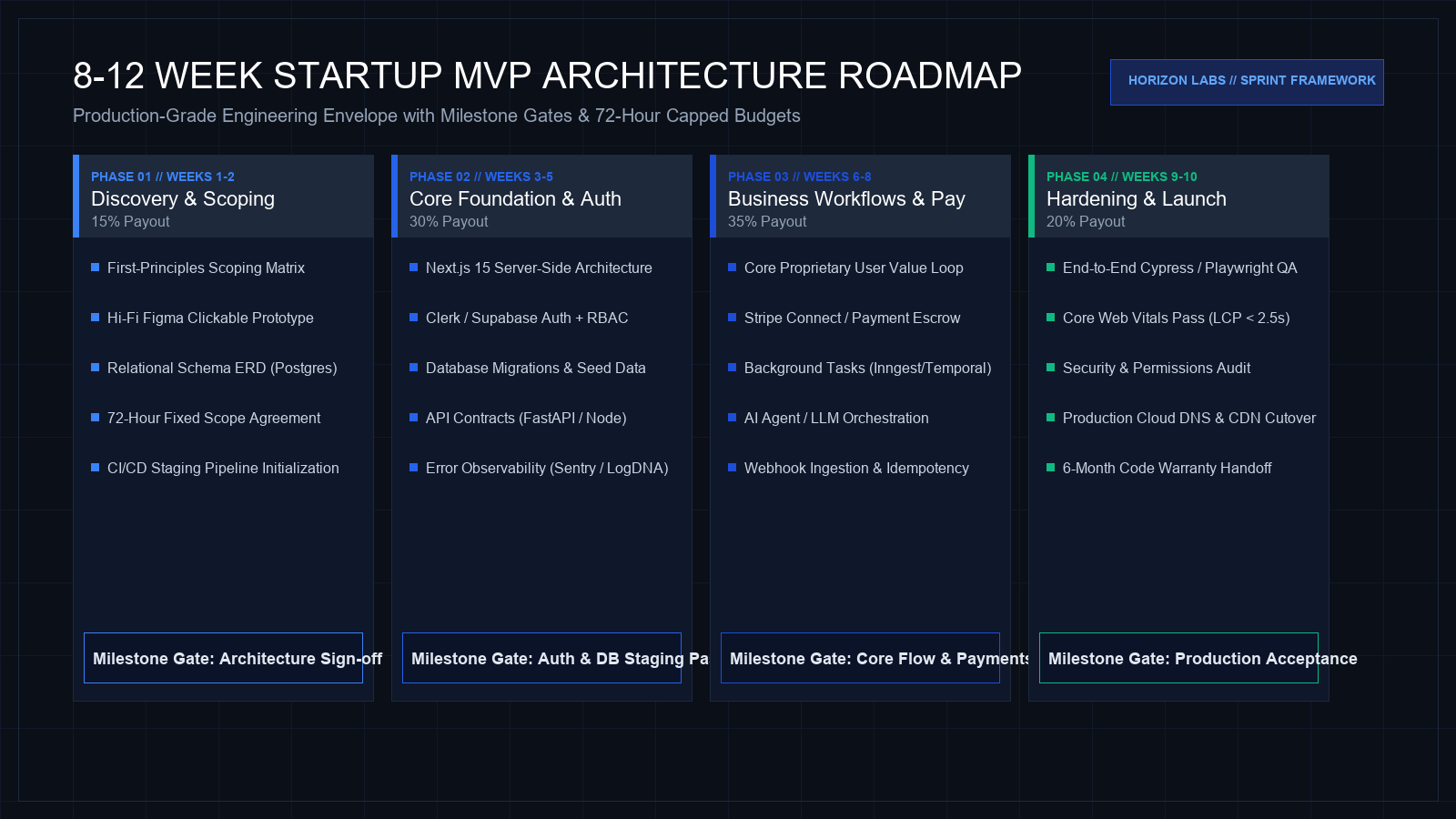
Review 8-Week Milestone DeliverablesHourly billing exposes founders to unchecked budget expansion. To eliminate financial variance, Horizon Labs structures client projects using a 4-stage milestone framework:
Each milestone requires explicit written sign-off by the founder following a live video demonstration in staging before funds are disbursed from escrow.
Schedule a direct 30-minute technical scope review with Sinan Sari (Co-Founder, Horizon Labs; former CTO of Cuboh, YC S19). We review database schema, tech stack trade-offs, and fixed milestone pricing with a guaranteed sub-1 hour booking confirmation.
Schedule Technical Review with SinanHorizon Labs has engineered venture platforms across Y Combinator batches and venture studio portfolios:
These engagements prove that fixed-milestone agency engineering provides venture-grade software velocity without diluting founding equity.
Our standard production build sprint takes between 8 and 12 weeks from technical kickoff to production launch. We define all user stories, database schemas, and API requirements during a 2-week architectural planning phase.
All source code, database architectures, documentation, and digital assets are 100% owned by the client. Full intellectual property assignment executes automatically upon final milestone invoice settlement.
We work in 2-week agile sprints. If feature priorities change, we exchange scoped tasks of equivalent engineering effort without altering total project cost. If additions exceed the original scope, we provide a transparent, written change order before work begins.
Yes. Every Horizon Labs contract includes a 6-month production warranty covering bug fixes and regression resolution at zero additional cost. We also provide ongoing engineering support pods on a month-to-month basis starting at $100 per hour.
Tell us what you're building. After an intro call with our founders, you'll hear back within 72 business hours: a written scope with an hour range and a hard ceiling, or the questions we need answered first.